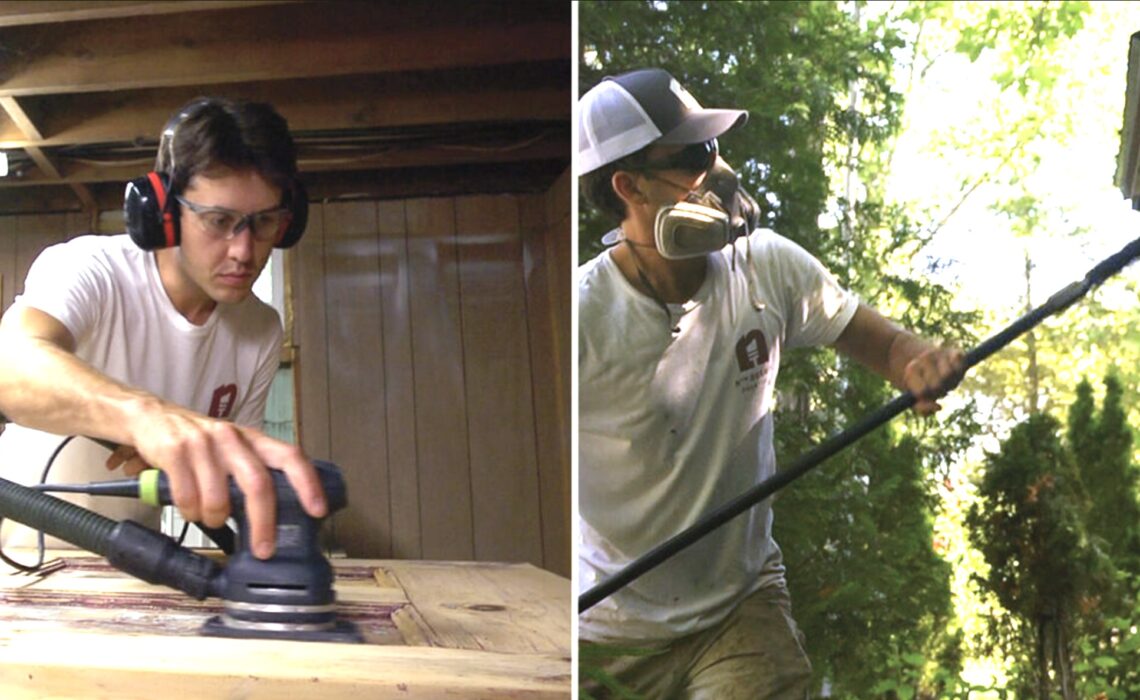
Noah Kanter worked on a paint crew over summers and breaks to help pay for college. Now it has turned into his chosen career.
This summer, PPC hit the road for two days with Kanter, the owner of Nth Degree Painting in Burlington, Vermont.
You have a college degree. Why choose a career in painting?
After college, I became an archaeologist for a little while and then I decided that wasn’t going to be my future. I looked at what I knew and what I enjoyed in the past and realized that I actually enjoyed the act of painting. I liked the physicality of it. I liked changing the world around me. People love the difference in their homes when they’re painted. I also noticed it was a great line of business. There’s always demand for it, and there are not enough people doing it. So, you put all of that together and it’s a great way to make a living.
What would you say to those who think college and skilled trades are mutually exclusive?
I don’t think just because you went to college means you shouldn’t go into the skilled trades. And I don’t mean to be divisive here. I don’t want to elevate the skilled trades over college, but I don’t think college should necessarily be elevated over the skilled trades either. I think you can do both and that’s an okay choice. I know that my painting career and my painting business has benefited because I did go to college.
How is that?
You know, more education is never a bad thing. I think spending time in college helped me learn to think abstractly. Just broadening your horizons a little bit. That’s not going to hurt you going forward. I think it can pay dividends in almost any lifestyle you choose.
What have been some of the most important turning points so far in the growth of your company?
I started on my own in January 2014, and ran the business like that for a while. I would work like a dog for months and then I would run off and go backpacking for a few months after that. And that was fine for me at age 24 or 25. It was good money and I was happy with the work, but I wasn’t really developing as a business. I realized that I had just a job and I created my own rat race really. So there was a big transition where I really looked at all of my systems and my processes and just what kind of a lifestyle I wanted to create for myself, and revamped everything.
In 2019, you hired your first employees. Why make the leap?
I chose to hire because I really had hit a ceiling. I could do no more as a one-man show, in terms of production and profitability.
What were your biggest challenges?
I think the biggest challenge for me with hiring for the first time was mostly mental. It just felt like it was a whole lot to do in addition to all my other duties. When you look at all the compliance and all the regulations, it just felt like, “Oh my God, I have to do this as well?” It turns out that’s mostly unfounded. There are great programs and systems and accountants that help you manage this. I’m so glad I did it.
What are you doing differently now that you have employees?
I started out as a solo guy, so every minute on a job site was go, go, go. Then you have a super green, fresh employee and you have to stop and teach. It all really starts with finding the right person and then slowing down and giving them the time of day and setting them up for success.
How do you find qualified workers?
In terms of who to hire, I followed the Nick Slavik “decent human being” hiring approach. Nick Slavik is a great contractor and thought leader out of Minnesota and he puts out a lot of good content about hiring and what he’s doing for his painting business. Instead of trying to hire people with experience, his approach is to hire a decent human being with little to no experience and mold them after you. I live in a college town – Burlington, Vermont – and there is not a shortage of college labor around here. So, I hit the schools first and did very well with that approach.
What are you doing differently now that you have to manage people?
My role has changed considerably since I hired. At first, the big transition for me was that instead of spending every minute on the job site, I now have a super green, fresh employee and I had to stop and teach. So, that was another hat I had to learn to wear and that was a transition for me – going from go, go, go to teach, teach, teach. It involved slowing down and putting myself in the total beginner shoes again.
What are the benefits?
After a few weeks, I started noticing that I was doing far less of the entry-level repetitive tasks. In a few more weeks I was able to delegate even more and then I was able to quarterback jobs at a different level with so much more room to really think about my processes. So I’m glad I did it. It is absolutely worth it. It all really starts with finding the right person and then slowing down and giving them the time of day and setting them up for success.
What are your go-to paint products and how do these help you provide consistent quality work for your customers?
For interiors, my go-to products are Cashmere® for the walls and I’m starting to really love the Emerald® Urethane Trim Enamel for trim. That combination cannot be beat on all levels and clients love it.
For exteriors, one product that really stands out to me is Snap Dry™ Door and Trim Paint. That product allows me to paint doors – I usually spray paint them – and close them an hour later and not worry about it. That really increases my efficiency on exterior projects. I don’t have to prop the door open for three hours and let all the flies in the clients’ homes. I can spray out a beautiful metallic looking factory finish and walk away after an hour. That helps me out a lot.
In what other ways does your paint supplier play a role in your success?
Sherwin-Williams helps me on two different levels. The first is the local level, at each individual store. All of the sales clerks and the managers are knowledgeable and fast at turning around orders. That really matters if you’re a paint contractor. You have a lot of stuff to do.
The reps too, have also been a fabulous asset to me. I can think of one story: on a Friday, in early afternoon, I was spraying out a job with a handheld gun and it broke. I called my rep Cody Marchand and a few minutes later he was on a ferry going from Burlington to New York to Plattsburgh to get me a new gun and drive it back down so I could finish this job on a Friday. That is the job of the rep. It’s to put out fires like that and solve problems for you. And that is a level of service that is just unexpected, which is what makes it special. That’s Sherwin at the local level to me.
At the corporate level, it’s even better almost. Because the reason I’m here doing this interview is because I heard their VP of Marketing, Jeff Winter, on a PCA podcast talking about the topic of young people in the skilled trades at a level of depth that I thought I was only thinking about. And the fact that their upper management is out there doing that and implementing programs to really dive deep on this topic like I am, that means a lot.
You’re a big believer in a healthy lifestyle, and making sure you get regular workouts outside of the job. Why is that, and how do you manage to fit it into your busy day?
As a paint contractor I make money with my body. If I’m not feeling good, if I’m not functioning at the highest level, I can’t earn as well, I can’t work as well, I can’t deliver for my clients. So to me it’s really important to wake up early at least a few times a week and do some sort of strength or conditioning or flexibility.
It’s easy to think that because I work physically hard with my body all day, working out in the morning could make the rest of the day a drag, but it actually has the opposite effect. Days when I wake up early, go for a long run or a swim, I am just on fire the rest of the day. Mentally and physically, I feel better. So to me it’s really important and I think if you wanna have a long career in this line of work, you need to treat your body really well.
A condensed version of this article was originally published in the Winter 2019 issue of PPC magazine. Noah Kanter is the owner of Nth Degree Painting in Burlington, Vermont and host of the Advice from a Young Tradesman podcast.