
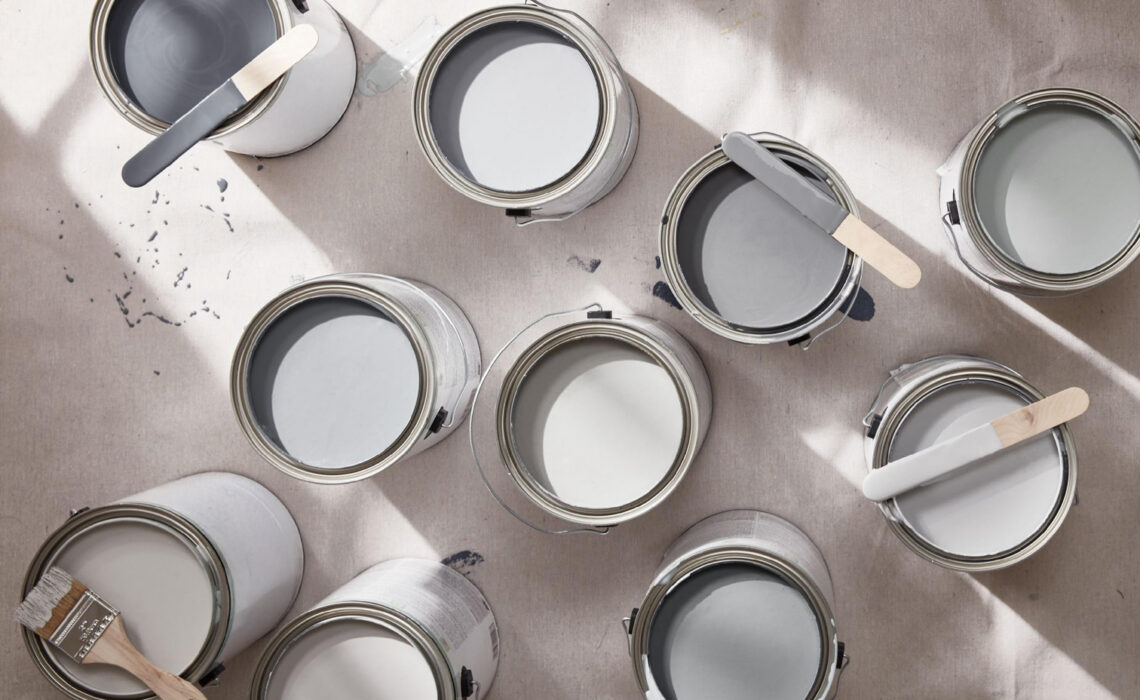
Have you ever looked at a painted wall and felt like the color doesn’t look the same on the wall as it did on the color chip? You may be dealing with a color undertone issue.
Most of the focus goes onto a paint’s mass tone – the paint’s obvious color, such as red, yellow or blue. But there are also undertones – like a hint of red in a beige, or green in a gray – that can affect the final product.
Undertones are the underlying hues that come from mixing different colors together, and they can affect how the final coating appears in different lighting or environments.
Check out our quick refresher below on everything the busy pro may want to know about color undertones.
- Not every color has a detectable undertone. In fact, the more intense the color, the less you need to worry about undertones. Undertones are primarily found in whites, neutrals and grays, and they can affect the final look.
- Undertones can be hard to spot – for you and your client. You might only be able to notice an undertone if you’ve practiced and trained to do so. Don’t expect yourself to be able to immediately see an undertone just by glancing at a paint chip.
- So how can you spot it? Comparison! The most effective way to find a color’s undertone is by comparing that color next to similar or complementary colors, in order to help reveal the undertone.
- There are only five possible undertones for beiges: red, orange, yellow, green, and purplish-brown.
- There are only four possible undertones for grays: green, blue-green, blue, and purplish-brown.
- Unlike gray and beige, white can have undertones of almost any color – including gray and beige. For conversations with customers, it might be more helpful to talk about whites in terms of “warm” (red/orange/yellow) and “cool” (green/blue/purple) undertones.
- The lighting of a room can also affect how strongly a color’s undertones come through. Soft white lighting will usually emphasize warmer undertones, while daylight or cooler lighting will heighten cooler undertones.
- As a rule, it’s best to match the undertone of the trim to the main color – not a secondary or accent color.
- Stuck trying to figure out the right white for a project? On the back of any color chip, under complementary colors, the first one listed is usually the coordinating white. If the home already has white walls or trim, that’s the white to continue using in all rooms. Using the same white throughout the home helps tie the rooms together.
More in our Color Education Series: 7 Things Every Pro Painter Should Know About Sheen
For more on these points as well as interactive tests – like whether you can identify a color’s undertone just by looking at it – don’t miss out on the Pro Color Training Series in Sherwin-Williams Learning Pathway®. Acting as a “road map for the Pros,” Sherwin-Williams Learning Pathway offers online education and resources for paint pros at every stage in their career—from new upstarts to veteran painters with decades of experience.
The free Pro Color Training Series is designed for pro painters to communicate clearly and confidently, enabling them to build trust, boost sales, and stand out by delivering fast, expert guidance on color choices. Modules include Color Harmony, Identifying and Working with Undertones, How Light Affects Colors, and much more.
Sign up and start training for FREE today here.
©2026 Fusable.